
By Michael Tosin Adesanwo | Data Science Student · Global Mobility Researcher · Founder, Bamilor International
📅 Published: May 2026 | ⏱ Reading time: 8 minutes
I have lived across three continents — Nigeria, Brazil, and Portugal. Every time I crossed a border, I carried hope, a strategy, and a bag full of paperwork. This article is for everyone trying to do the same.
Portugal quietly crossed a milestone in 2024.
For the first time in its modern history, the country’s immigrant population surpassed 1 million people — representing over 10% of the entire national population. That is not a small number for a country of 10 million.
But the conversation around Portugal’s immigration story has become noisy, politicised, and in many cases, misleading. Social media is full of influencers selling guarantees, governments announcing reforms, and immigrants sharing stories of long waits and broken systems.
So I decided to go to the data.
I built an interactive immigration impact dashboard — pulling from official sources including SEF/AIMA, INE, PORDATA, Eurostat, and the World Bank, to cut through the noise and show what is actually happening on the ground.
👉 Explore the full interactive dashboard here →
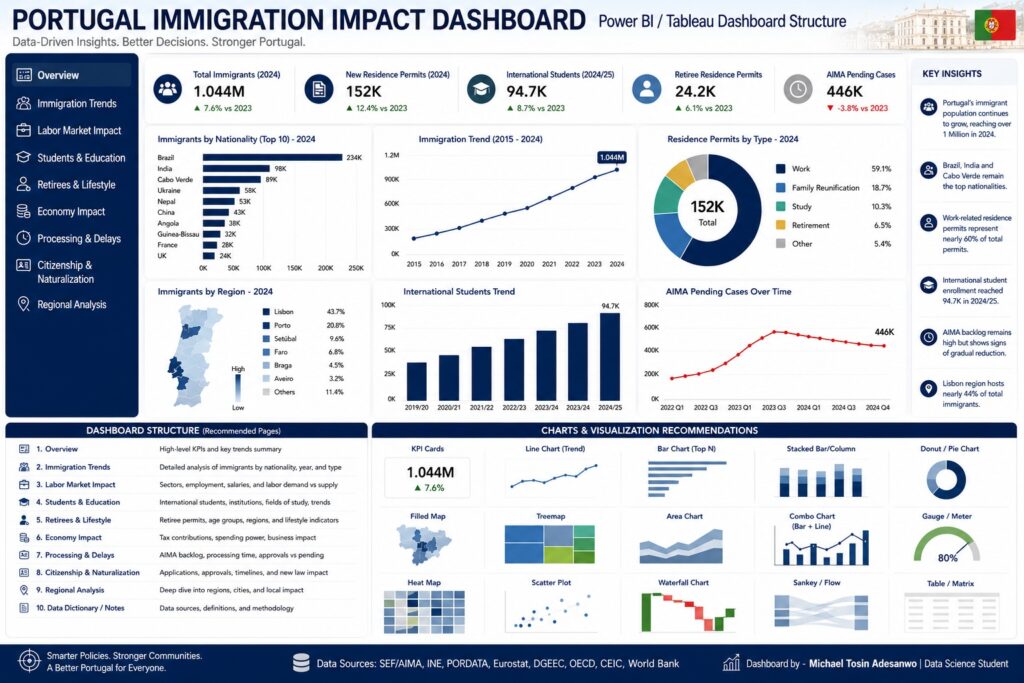
In this article, I will walk you through the most important findings, what they mean in real terms, and what anyone planning to move to Portugal needs to know right now.
The Numbers First: Portugal’s Immigration at a Glance (2024)
Before we get into the analysis, here are the headline figures:
| Metric | 2024 Figure | Change vs 2023 |
|---|---|---|
| Total immigrants | 1.044 million | ↑ 7.6% |
| New residence permits | 152,000 | ↑ 12.4% |
| International students | 94,700 | ↑ 8.7% |
| Retiree residence permits | 24,200 | ↑ 6.1% |
| AIMA pending cases | 446,000 | ↓ 3.8% |
Two things stand out immediately.
First, immigration is still growing across every category — students, workers, retirees. The narrative that Portugal is “closing its doors” does not match the data yet. What has changed is how people are entering, not whether they are entering.
Second, despite a slight reduction, the AIMA backlog at 446,000 pending cases is still enormous. That number represents real people in limbo — waiting for biometric appointments, renewals, family reunification approvals, and legal status confirmations.
Who Is Coming to Portugal?
The top 10 nationalities in 2024 tell an interesting story:
- Brazil — 234,000 (by far the largest community)
- India — 98,000 (fastest growing)
- Cabo Verde — 89,000 (long historical ties)
- Ukraine — 58,000 (driven by displacement)
- Nepal — 53,000 (significant labour migration)
- China — 43,000
- Angola — 38,000
- Guinea-Bissau — 32,000
- France — 28,000
- United Kingdom — 24,000
The dominance of Portuguese-speaking countries — Brazil, Cabo Verde, Angola, Guinea-Bissau — reflects both cultural and historical ties. The surge in Indian and Nepali migration reflects Portugal’s growing role as a gateway into the European labour market.
What the raw numbers do not show is that the nature of migration is shifting. Brazil and Cabo Verde are established communities with generational roots. India and Nepal represent newer, more economically-driven migration flows, primarily through work permits.
Where Are Immigrants Settling?
The concentration data is one of the most striking findings in the dashboard:
- Lisbon metro area: 43.7% of all immigrants
- Porto metro area: 20.8%
- Setúbal: 9.6%
- Faro (Algarve): 6.8%
- Braga: 4.5%
- Aveiro: 3.2%
- Rest of Portugal: 11.4%
Nearly two thirds of all immigrants in Portugal live in just two metro areas — Lisbon and Porto.
This creates a visible paradox: those two cities face housing pressure, infrastructure strain, and rising costs, while much of interior Portugal struggles with depopulation, labor shortages, and ageing communities.
The data strongly suggests that Portugal’s immigration distribution problem is as significant as its immigration volume question. Rural and interior regions have enormous capacity to absorb newcomers — but the services, transport links, language support, and community infrastructure are simply not there yet.
Why People Come: The Permit Breakdown
New residence permits in 2024 broke down as follows:
- Work permits: 59.1% — the clear majority
- Family reunification: 18.7%
- Study: 10.3%
- Retirement: 6.5%
- Other: 5.4%
Three out of five immigrants arriving in Portugal came to work.
This matters enormously in the context of the new immigration reforms. Portugal’s government is tightening pathways, but the largest category of arrivals is driven by economic need, both the immigrant’s and Portugal’s own labour market.
The AIMA Crisis: What the Backlog Really Means
When SEF (the old immigration agency) was dissolved and replaced by AIMA in 2023, it inherited hundreds of thousands of unresolved cases. The backlog tells the story clearly:
- Q1 2022: ~220,000 pending cases
- Q3 2023 (peak): ~590,000 pending cases
- Q4 2024 (current): 446,000 pending cases
The improvement is real, but at current processing rates, clearing the backlog fully will take years, not months.
For anyone on the ground, this translates to:
- Biometric appointments booked 6–18 months out
- Renewal delays leaving people in legal limbo
- Family reunification cases sitting unresolved for over a year
- Entrepreneurs and skilled professionals unable to access the system at the speed they need
The AIMA problem is not just a bureaucratic inconvenience. It is a human dignity issue affecting over 400,000 people right now.
The Contradiction at the Heart of Portugal’s Immigration Policy
Here is the tension that the data makes unavoidable.
Portugal has:
- An ageing population — the 65+ index grew from 100 in 2015 to 128 by 2024
- A low birth rate — one of the lowest in Europe
- Chronic labour shortages in agriculture, hospitality, construction, caregiving, and logistics
- An emigration problem — young Portuguese professionals continue to leave for higher wages elsewhere
And yet immigration policy is moving toward restriction, qualification filters, and longer waiting periods.
Both things are simultaneously true: Portugal needs more immigrants to sustain its economy and social security system, and Portugal’s administrative infrastructure is genuinely overwhelmed.
The question is not whether to allow immigration. The question is whether Portugal can build the capacity to manage it humanely and efficiently.
What This Means If You Are Planning to Move to Portugal
The rules have genuinely changed. Here is what you need to know:
For job seekers and workers: Apply from your home country. The old pathway of arriving on a tourist visa and regularising later is largely closed. Get your job offer, gather your documents, and apply through the proper consular route before you board a flight.
For international students: Portugal remains one of the best-value study destinations in Europe, lower tuition than the UK or Netherlands, Schengen access, a growing tech ecosystem. But secure your student visa before arrival and start your residence permit process immediately upon landing. Delays compound fast.
For entrepreneurs and business owners: Understand that administrative timelines in Portugal are long. Budget 6–12 months for any permit process. Engage a qualified immigration lawyer — not a social media consultant, a licensed professional who knows the current AIMA procedures.
For retirees: The lifestyle appeal remains strong. Healthcare, climate, safety, cost of living relative to Western Europe, it is still genuinely attractive. But research your specific region carefully. Healthcare access varies significantly between Lisbon and rural areas. Budget conservatively for housing, which has risen significantly since 2019.
For families: The new family reunification rules require 2 years of legal residence before bringing dependants in most categories. Plan your timeline accordingly. Separation has real costs — financial, emotional, and professional.
The Opportunity Inside the Challenge
I want to be direct about something.
I moved to Portugal as an immigrant. I run a global mobility advisory business — Bamilor International — specifically because I know how difficult and confusing relocation can be, especially for people coming from emerging markets or diaspora communities.
The story I see in this data is not a story of a country closing. It is a story of a system under pressure that has not yet found its equilibrium.
That creates real opportunity for people who come prepared:
- Who understand the legal pathways
- Who arrive with proper documentation
- Who have realistic financial buffers
- Who are willing to integrate, not just relocate
Portugal still rewards those people. The bar has simply gotten higher, which means the gap between prepared and unprepared migrants has never been wider.
Explore the Full Data
Everything discussed in this article is visualised in the interactive dashboard I built as part of my Data Science programme.
It covers all 9 data categories — immigration trends, labor market impact, student enrollment, retiree patterns, AIMA processing data, economic contributions, citizenship timelines, and regional breakdowns — with live charts you can interact with.
👉 Open the Portugal Immigration Impact Dashboard →
Sources
All data in this article and dashboard is drawn from:
- SEF / AIMA — Serviço de Estrangeiros e Fronteiras / Agência para a Integração, Migrações e Asilo
- INE — Instituto Nacional de Estatística (Portugal)
- PORDATA — Base de Dados Portugal Contemporâneo
- Eurostat — European Commission Statistical Office
- DGEEC — Direção-Geral de Estatísticas da Educação e Ciência
- OECD — Organisation for Economic Co-operation and Development
- World Bank — Global migration and demographics data
Note: Some figures are estimates or projections based on available official data. Readers are encouraged to verify against the most current official releases.
About the Author
Michael Tosin Adesanwo is a global mobility researcher, UX/UI designer, and multi-venture founder based in Lisbon, Portugal. He is currently enrolled in a professional programme in Data Science, Machine Learning & AI. He is the founder of Bamilor International, a global mobility and relocation advisory practice, and the author of The Silent Battles Abroad.
He writes about immigration, data, global mobility, and building a life across borders at HistoryMaker101.com and on LinkedIn.
Tags: Portugal immigration 2025, moving to Portugal, Portugal expats, AIMA delays, Portugal residence permit, Portugal visa, relocate to Portugal, Portugal immigration reform, international students Portugal, Portugal digital nomad